The truth will out
The prediction market "Truth Machine" grinds to a halt

What is reality?
As the last decade of politics has shown us, the concept of one unified objective truth simply isn’t possible anymore.
Journalism is meant to call balls and strikes and expose objective reality. Now, literal balls and strikes get ABS to decide if a Nolan McLean wobbler is juuuust a bit outside.
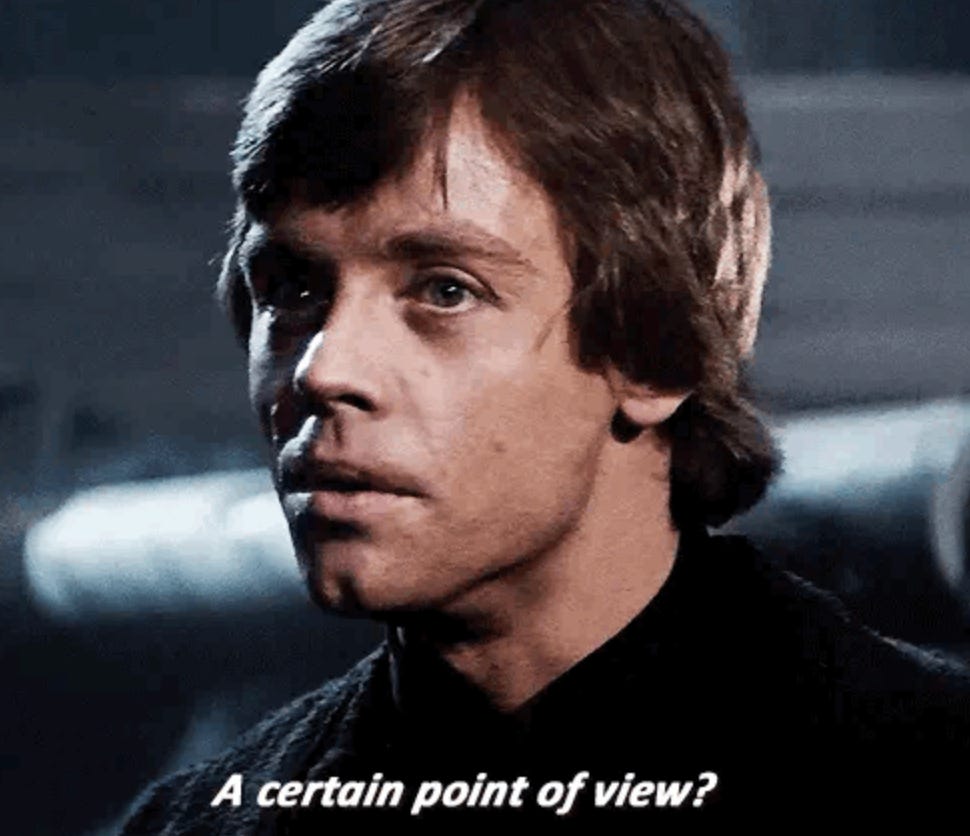
Yet our American empire lumbers forward, fueled by reality-bending hot takes on everything from the Bowling Green Massacre to the Peace President, to the up-is-down ministroke we all suffered with the Blue/Gold dress debates.
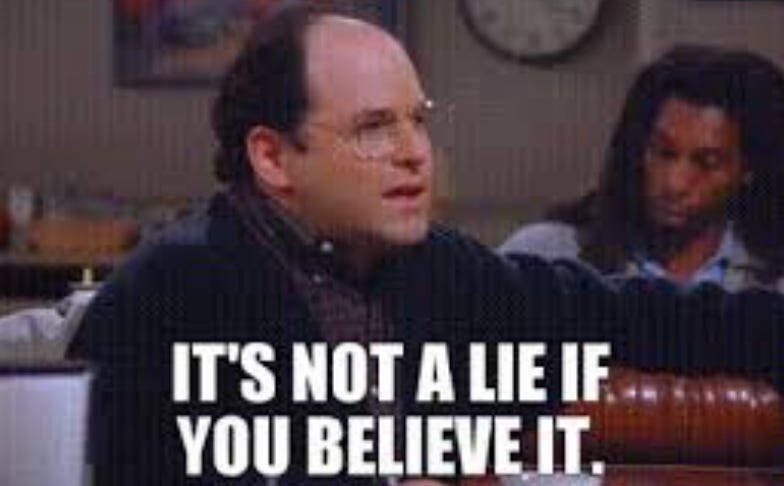
It’s not a lie if you believe it
Perception is reality. What you *feel* is more accurate than what is in front of you. “Yeah, but still…” and “Okay, but whatabout…” allow partisans to wave away facts and reality that could puncture the safe bubble of mental protection.
Half-truths and wishcasting bleeding into fever dreams seen through squinting bloodshot eyes locked on fuzzy CRTs.
Mandela effects. Berenstain Bears. Kazaam. Laurel. Yanny. Pizzagate. Butler. Epstein. Hunter’s laptop. Jobs data. Pass interference. Zelenskyy’s suit. Maduro’s capture.
So what then is the solution?
“A financial instrument, traded on or off an exchange, the price of which is directly dependent upon (i.e. derived from) the value of one or more underlying securities, equity indices, debt instruments, commodities, other derivative instruments, or any agreed upon pricing index or arrangement…”
What you just read is the definition of “derivatives” from the Commodity Futures Trading Commission (CFTC). A powerful, well-funded, and very vocal part of our culture and economy believe *that* is what will save us all.
Prediction markets.
Truth Machine go brrr
“Prediction markets have proven themselves to be the antidote. They mobilize the most elegant and effective properties of free financial markets towards the pursuit of unbiased truth. They are the quintessential truth machines,” wrote Kalshi CEO Tarek Mansour in his famous LinkedIn post last year.
It seems so perfect. A market-based pursuit of unbiased truth—bringing objectivity we all crave compiled by the wisdom of the crowd. The people united will never be defeated.
On its face, a potent and noble goal.
Unfortunately, it’s naive, craven, and hypocritical to champion prediction markets as tools to heal humanity’s fractures when they are easily-manipulated financial markets with perverse incentive structures.
Much has been made by commentators of prediction markets about their myriad flaws and failures. Subscribe to Event Horizon. I do. We won’t retread that too much.
Instead, let’s focus on what prediction markets are, what they claim to be, and what the business model actually means for culture and the country.
Markets = belief
As we read above, the CFTC definition of prediction market derivative swaps is…a lot. In general, the idea is simple, though: You are placing money on the likelihood of something to happen—yes or no. Someone else will take the opposite side. I think XYZ *will* happen. You say it *won’t.* Winner take all.
PM operators like Kalshi, Polymarket, Fanatics, FanDuel, DraftKings, and others operate these marketplaces to connect users to one another on everything from references on the Colbert show to crypto prices to LA Rams win totals.
The trouble is that the pure structure of the swap as a financial instrument is not at all what is happening in (oh god) reality.
Multiple legal battles from Nevada to New Jersey and beyond are embroiled over how sports play into CFTC rules and state rules regarding gambling. Operators build the apps and websites to mimic sportsbook rules, layout, and design, but users actually trade a federally-regulated event contract.
That sounds and (oh god, again) *feels* right on a lot of levels. I think the Avalanche will beat the Wild. I will risk money on my belief.
From one interpretation, that’s a sports bet. On another app, it’s a financial market swap on an event outcome. States regulate the bets. The feds regulate the derivatives.
Let’s go Avs.
So we ask again, what’s the actual reality?
Crossed eyes, palpitating hearts, everyone loses
The prediction market legalese and marketing are often at odds. And it’s not just with themselves, but with the entire purpose and intent of event contracts.
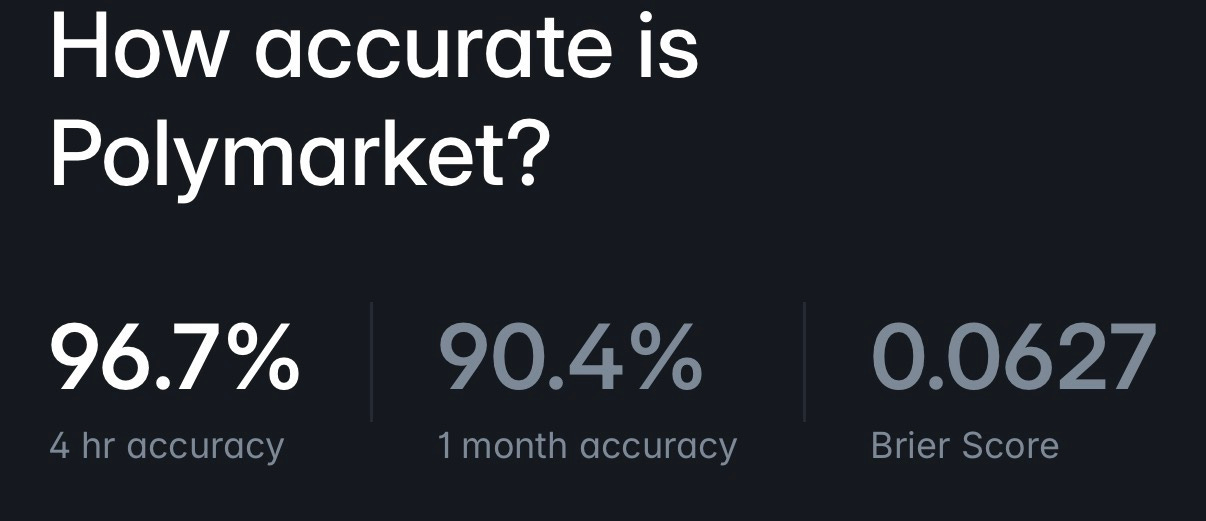
Remember, Mansour said they are truth machines. Polymarket even tracks objective reality by breaking down a rolling percentage of accuracy. They define it as “how often the top-voted outcome before a market closed ended up being right.”
The PMs crowed mightily when declaring early victory for Trump in the 2024 election. Academics found some truth to the market “knowing” more than pollsters.
The trouble is that actual reality is much tougher to predict consistenly. Zohran Mamdani’s historic primary victory in New York City is the perfect example. The truth machine wrongly, violently, hilariously biffed that battle between Mamdani and Andrew Cuomo.
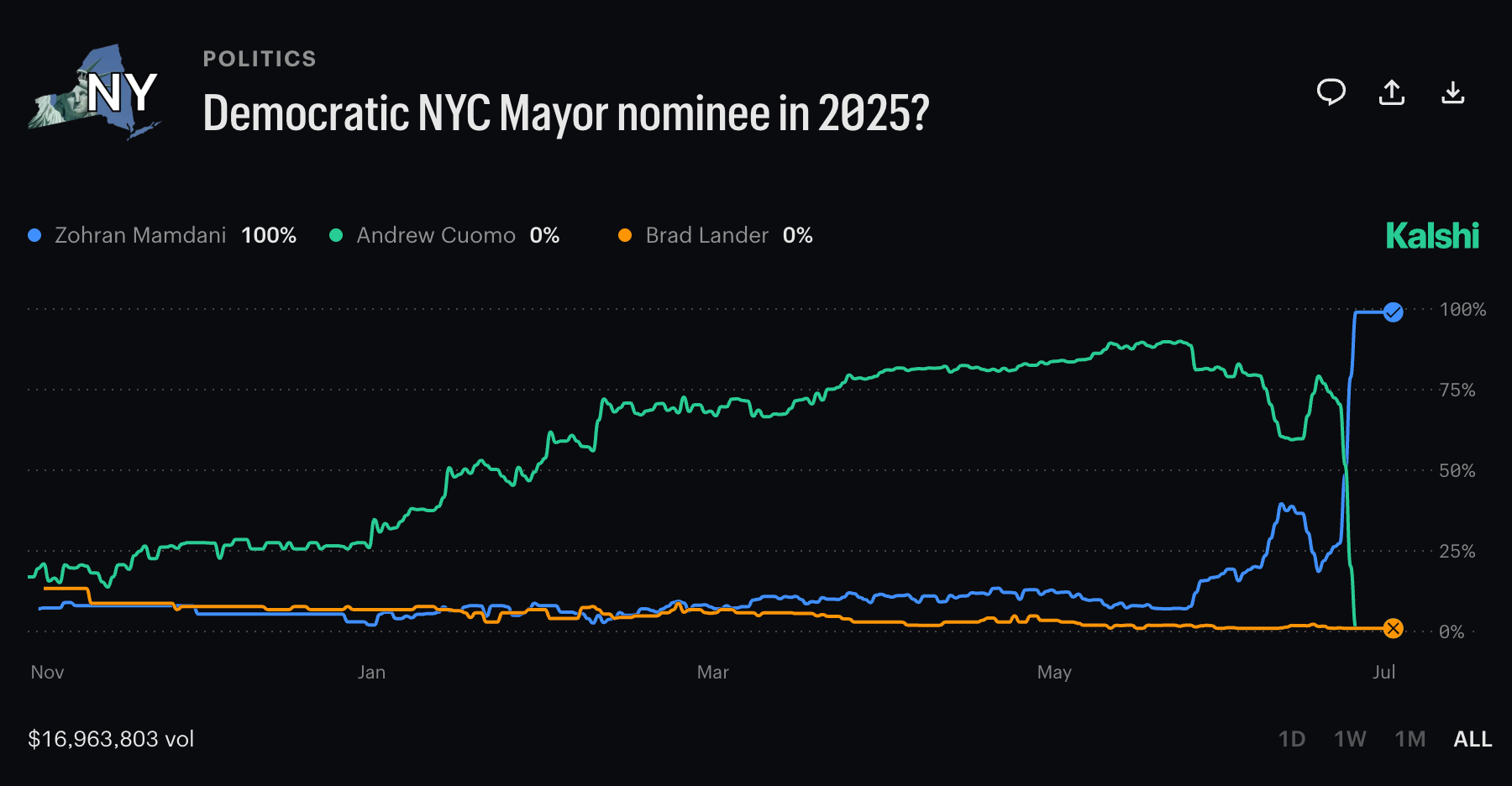
Nearly $17 million in trades flowed into the market, with Cuomo a healthy leader throughout the primary campaign. In fact, as your intrepid kid reporter noted, the market was absurdly incorrect at the moment it mattered most.
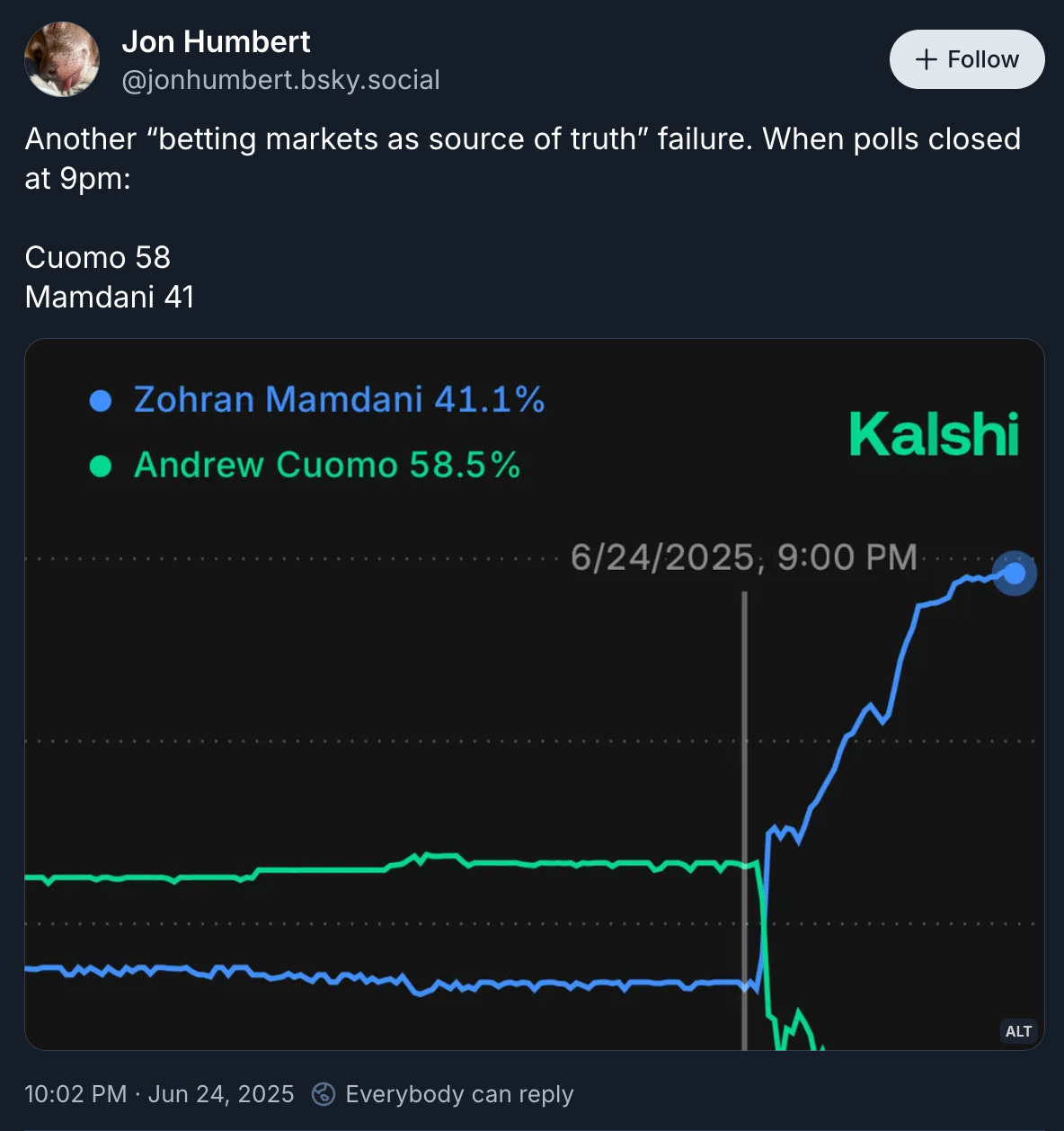
The *reality* was the difference between a 17-point loss and a 13-point win. The truth machine was wrong with a 30-point swing (yes, we’re conflating odds with voting numbers).
Then in the general election, even the margin of victory market was wrong—the eventual “9-11.99%” market was at a 10% likelihood of winning when polls closed in November.
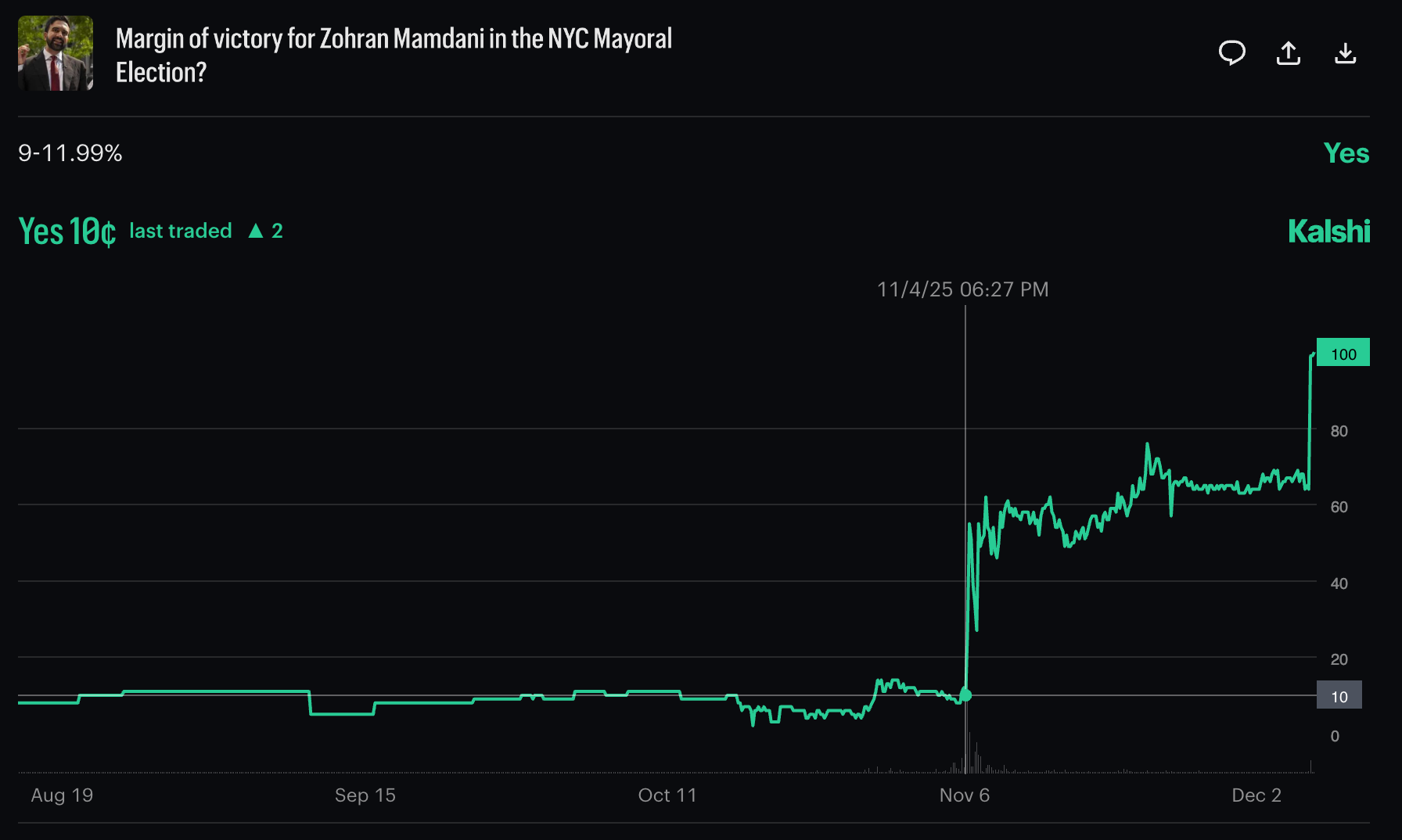
So the marketing doesn’t match the market. And it’s easy to see why.
Prediction markets aren’t about truth
Sure, blind squirrel, broken clocks, etc. etc. Kalshi called Trump. Gotcha.
Sample sizes are only as good as you make them. So what then are PMs actually for?
Hedging.

From the CFTC again: “Event contracts can be used to hedge, to offset real-world risks. As one example, a citrus farmer might buy a weather event contract to hedge against losses that might be caused by a sudden freeze. Event contracts also provide a way for traders to seek profits by taking risks, or speculating.” (emphasis theirs)
This is how prediction markets have operated for decades. Not as truth-seeking market-driven voices from beyond, but as a way to protect assets because you literally *don’t* know the truth.
These contracts can’t possibly be “the truth” when they are designed and used as arbitrage. It’s simple: If your machine can so correctly determine the outcome objectively, why take the risk?
If you know “the truth,” why do you need to hedge against it?
In fact, in the very dense and targeted content for institutional investors, Kalshi undercuts its own marketing and mystique by directly addressing trades as hedging: “By reducing the noise implicit in your investment, you can make trades precisely how you want them while providing a valuable price-based information signal to the world at large.”
How could there be “noise” when The Truth is right there?
Markets = belief. Marketing = validity. Reality = what you make it.
We’ll address it quickly because it’s been well-discussed elsewhere, but CNN and CNBC partnering with prediction markets is a concern.
The subtlety and nuance of what a market is “telling” us is far different than a poll, focus group, or even a man on the street interview.
These partnerships add the air of credibility and inevitability of the sites. The networks get a new datapoint and segment. The PMs get name recognition and mini advertisements. Corporate symbiosis since time immemorial. Nothing wrong with that in theory.
The trouble is reality can be manipulated and turned for a profit. The Maduro special ops soldier. The French weather-rigging. Mention market memes.

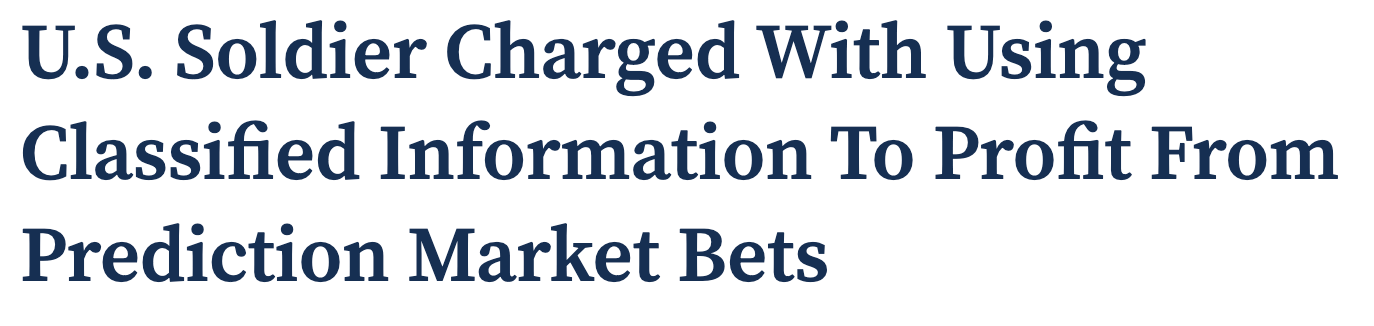
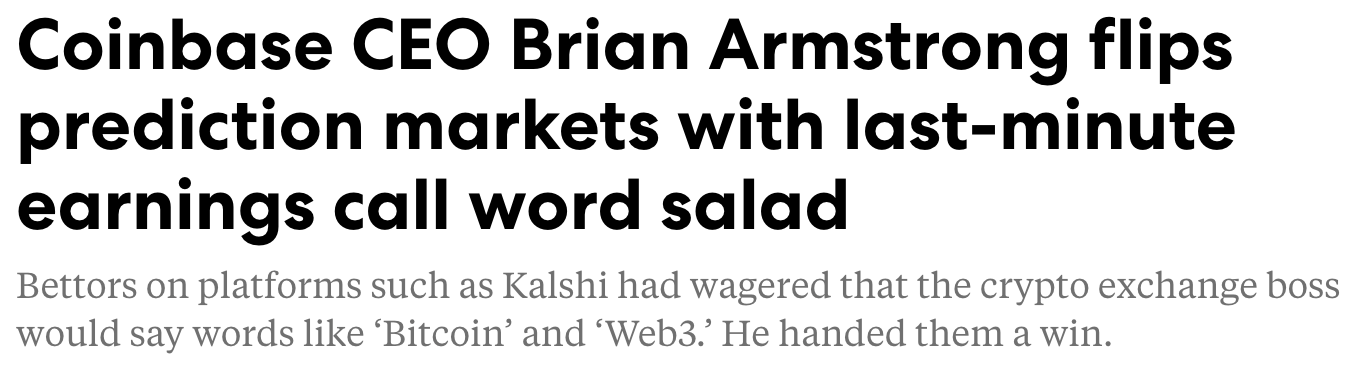
Insider trading is nothing new, but it’s seemingly never had more opportunities to thrive.
We can’t worship the all-knowing market and treat it with reverence when we *also* win money because a CEO said “blockchain” on a phone call. Because that’s really what this is all about.
Follow the money
Sportsbooks are pretty basic. It’s you versus “the house.” The odds change based on how much the book is taking action. They hedge in real time based on what bettors wager. Books know that their models and research will likely be more correct more often than the average bettor.
The sportsbook has no incentive on “reality.” Jets, Mets, Rafa, Real Madrid, it doesn’t matter. Did the traders do a good job adjusting the price based on models and orders? The “right” outcome only matters as it relates to the profit on the market.

“We could really use Baltimore and the points” you’ll hear on a Sunday morning from a risk manager. It’s a myth of course that bookmakers try to get balance on every bet. They follow the internal models and signals from the market to find the most profitable order flow and odds. That’s why even a great trader can get mauled when “customer-friendly outcomes” happen in the world of sports. Crazy things happen!
Prediction markets on the other hand? Order now. Order tomorrow. Order forever.
There aren’t fees for making a sports bet (in general) at a sportsbook. The trader risks a loss to pay you out when you win or keep your cash when you lose.
PMs only survive on users making orders. They charge fees based on a variety of factors like order size, current price, and much, much more.
Sportsbooks care about *what* you’re betting on. Prediction markets just want you to bet.
Those fees are often obscured, confusing, and part of what Issac Rose-Berman recently called “Kalshi’s Favorite Lie”---they need volume and orders to flow in. The trouble is that for someone to win, someone else has to lose, and PMs take a cut no matter what.
That incentive structure leads to the manipulation we see today. They don’t want truth. They want volume.
And some of “the truth” they’re selling literally has the thumb on the scales.
Pay for play
A large core of prediction market flow does come from average folks chucking a couple bucks into a market for a Karoline Levitt news conference or a Carolina Hurricanes moneyline wager.
But often, large institutional investors can be seeding markets and filling liquidity and volume to bring attention (or deflection) on certain outcomes.
No, it isn’t you versus Joe on the corner wagering opposite sides of the Duke game. It’s you versus a hedge fund potentially trade washing to create order attention and snap-adjustment of percentages right at market closing.
Not really a “quintessential truth machine” when it’s actually “a quant from SIG,” is it?
The other manipulation comes in the form of incentive and reward programs for volume and liquidity.
It’s part of the chicken and the egg for all exchange market economies: if no counterparties can be found, you can’t have a market. Someone has to take the opposite side.
So Poly, Kalshi, and others have reward and loyalty programs if you seed and fund markets to get attention. You get paid extra when you act as a market maker for select types of contracts. Gotta spend money to make money, right?
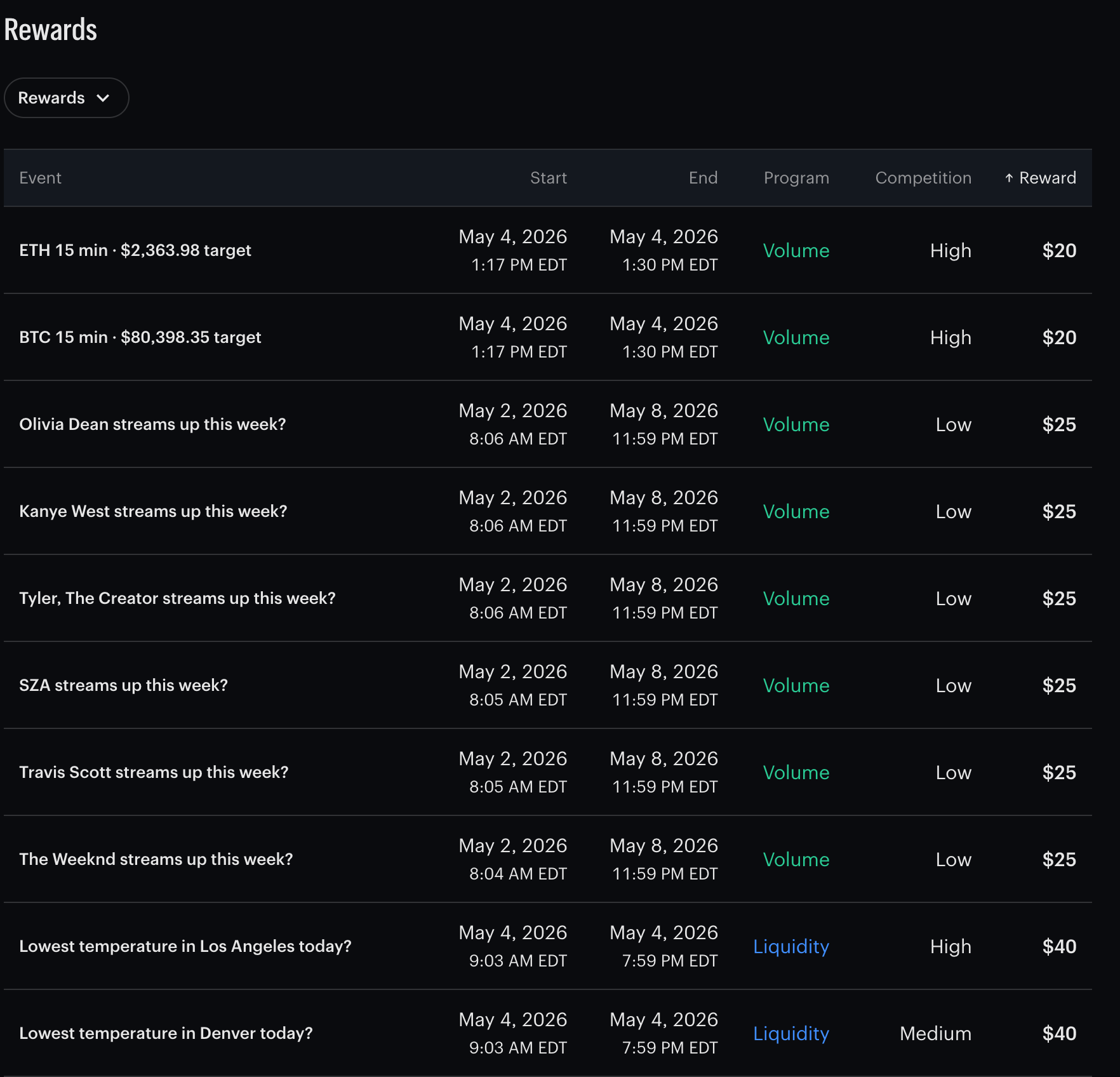
Polymarket says of its program: “Deeper liquidity means tighter spreads, lower price impact, more reliable fills, and greater resilience during volatility. Maker Rebates incentivize consistent, competitive quoting so everyone gets a better trading experience.”
Kalshi adds, “The more you trade in eligible markets, the more rewards you earn. It is designed to encourage trading activity and make markets more active for everyone.”
The (here we go) reality is this: No one is going to trade into a market with little action. PMs say instead, we gotta kickstart this thing, so we’ll pay you to get the ball rolling, regardless of the truth behind a market.
Feed the beast.
Market-making incentive programs don’t get as much attention as they should. Again, follow the logic. If we’re talking about truth and market forces are all-knowing and 90%+ correct, shouldn’t the Invisible Hand have the cream rise to the top?
Why do we need incentives to artificially prop up specific markets and contracts?
A well-fed system gets traction, boosts social media chatter, gives media partners something to chat about, and volume creates more volume. Churn, keep the momentum and orders coming, and hammer the checks with fees on every trade.
You aren’t an arbiter of truth. You’re a bounty hunter.
If a sportsbook sets a line on the Steelers against the Texans and the action is one-sided, they change the spread. The market spoke, the book was off, and traders adjusted. It didn’t need to use a secondary rewards system for deep-pocketed users to goose interest.
There’s no way to know how much of that prediction market volume and liquidity is truly “trading what you know” or if it’s bonus hunters gaming payouts and fees.
Where’s the “truth” there?
Just the facts, ma’am
Recently, multiple outlets have uncovered the imbalance between winners and losers on PM sites. Much like the economic reality in the country writ large, “the haves” are having a field day and the minnows are being devoured.
Obviously, addiction is a very real and serious challenge across all forms of wagering, and sportsbooks have been taken to task when falling short.
But there is an honesty in what a bookie does. Set the line, take the bet, let the chips fall where they may. Yes, the core math is tough for most to become a profitable pro, but that’s gambling. At least you aren’t being told a sportsbook is a source of truth or path to financial freedom.

The industry at large needs to come down to earth just a bit. Prediction market volume is predominantly sports contracts because sports betting isn’t available nationwide, and PMs offer approximately the same thing as existing sportsbooks. This is not rocket science or a secret.
That fight will end up in the Supreme Court sooner rather than later and state regulators may face a financial reckoning if the CFTC becomes a national gaming commission.
But let’s just be clear about truth and reality, especially at this moment in our country’s history.
Clarity, context, and disclosures
To give some background and flavor, I am a former investigative journalist, government spokesperson, and customer operations content manager for FanDuel. I loved my time there and helped create the FanDuel Predicts’ education content. FD’s prediction market product has promise and recent promotions helped boost installations.
The company has made no bones about preferring the traditional sportsbook model and design. It’s the best for a reason. But at no point has anyone believed that PMs can be truth tellers. It’s a marketplace. We made it a point to be clear-headed and adults about the product.
It’s also not lost on me that Substack itself now has an integration with Polymarket right here on the world wide web. PMs are inescapable.
The legal minefield of “no it’s not actually betting, it’s derivative swaps on events” is being tested, sometimes failing, and is tough to defend.
But it’s a line of logic that’s found traction in the vacuum of vague legislation and slow-acting state bodies.
Add in the move-fast-break-things tech attitude and well, *that’s* the truth and reality we’re all living in now.